Home
Home HSFUJI
  Mar 27,2026
What Is the Difference Between a Villa Elevator and a Standard Home Elevator?
When planning to install an elevator, many homeowners assume that a “villa elevator” and a “standard home elevator” are essentially the same, just described differently. However, in real projects, these terms often reflect different design approaches and usage priorities.
If this distinction is not clearly understood from the beginning, it can lead to mismatches in actual use—such as inefficient space utilization, unsatisfactory user experience, or a lack of integration with the overall living environment. For homeowners who value long-term comfort and practicality, this difference is worth careful consideration.
Different Positioning Leads to Different Design Approaches
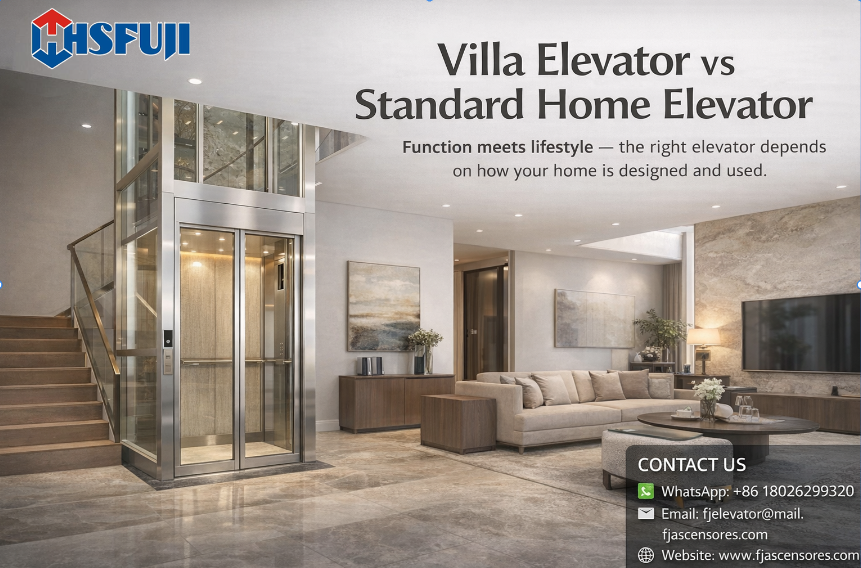
In general, standard home elevators tend to focus more on functional practicality, addressing basic vertical mobility needs within the home. Villa elevators, by contrast, are often considered part of the living space itself, where both functionality and overall experience play important roles.
This difference influences the design priorities from the early stage. While standard home elevators typically emphasize practicality and cost efficiency, villa elevators often require a balance between safety, comfort, and design integration.
At HSFUJI ELEVATOR, every project begins with a clear understanding of how the elevator will be used. Instead of recommending a predefined product, the goal is to determine whether the project requires a function-oriented solution or a more experience-oriented approach.
Design and Aesthetics: More Than Just Appearance
Many buyers initially focus on visual differences, but the distinction goes beyond appearance alone.
Villa elevators are more likely to involve customized design elements, such as glass shafts, panoramic cabins, and tailored interior finishes, allowing the elevator to integrate naturally into the architectural space. Standard home elevators, on the other hand, often adopt more standardized configurations with a stronger emphasis on practicality.
The key difference is not simply how the elevator looks, but how it fits within the overall environment.
HSFUJI ELEVATOR places greater emphasis on ensuring that the elevator aligns with the building’s architectural style, rather than treating it as an isolated product.
Configuration and System Matching Determine Long-Term Experience
Behind many pricing differences, the real factor is not just branding, but how well the system configuration matches the actual usage requirements.
Villa elevators typically require higher standards in ride smoothness, noise control, and door operation quality, contributing to a more comfortable daily experience. Standard home elevators, while still reliable, are often configured to meet essential performance needs with a stronger focus on cost efficiency.
Using a purely function-oriented configuration in a high-expectation living environment may lead to dissatisfaction over time.
HSFUJI ELEVATOR focuses on fit-for-purpose system design, ensuring that each configuration aligns with the specific needs of the project.
Installation Conditions and Space Planning Are Not Always the Same
In many villa projects, elevator space is considered during the architectural design stage, allowing for better optimization of shaft size, layout, and traffic flow. However, this is not always the case, as some villa elevators are also installed in existing buildings.
Standard home elevators are often installed in a wider range of scenarios, including both new constructions and retrofit projects, where space limitations may influence design choices.
This is why some installations appear fully integrated, while others may feel like later additions.
HSFUJI ELEVATOR conducts detailed site evaluations to provide practical layout solutions that minimize impact on existing structures while maintaining usability.
Price Differences Are Driven by Requirements, Not Labels
A common question is whether villa elevators are always more expensive. In reality, pricing is not determined by the label itself, but by factors such as configuration level, design complexity, and installation conditions.
A highly customized elevator solution will naturally involve higher costs, while a more straightforward setup can effectively meet basic needs at a lower budget.
The key is to select a solution that truly matches the intended use, rather than relying on product categories alone.
HSFUJI ELEVATOR approaches pricing based on project requirements, ensuring that each proposal reflects actual needs instead of predefined classifications.
Choosing the Right Solution Matters More Than Choosing the “High-End” Option
In practice, many issues arise not from the product itself, but from an inaccurate decision made at the early stage.
Some homeowners choose a basic solution but expect a premium experience, while others invest in high-end configurations that exceed their actual needs. Both situations can lead to inefficiency or unnecessary cost.
An elevator is a long-term investment, and suitability is more important than positioning.
HSFUJI ELEVATOR focuses on delivering solutions that match real usage scenarios. Although this approach requires more detailed communication upfront, it ultimately results in a more reliable, comfortable, and cost-effective experience over time.
 What Is the Difference Between a Freight Elevator and a Passenger Elevator?