Home
Home HSFUJI
  Mar 26,2026
What Is the Difference Between a Freight Elevator and a Passenger Elevator?
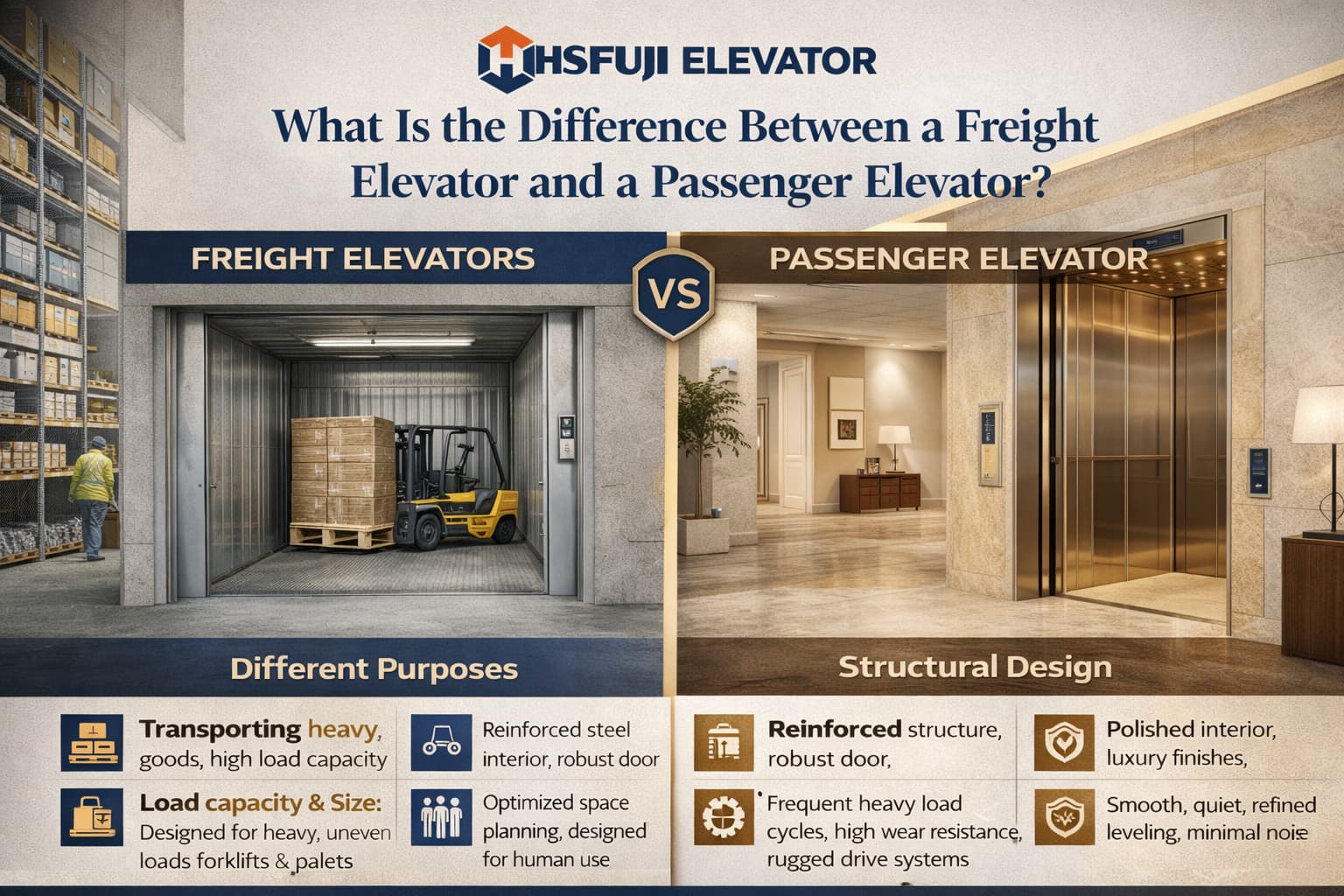
When selecting an elevator, many buyers initially assume that as long as it moves up and down, the difference is minimal. However, in real-world use, the gap between a freight elevator and a passenger elevator becomes very clear over time.
Choosing the wrong type can affect operational efficiency, increase maintenance costs, and even create unnecessary long-term risks. For projects such as warehouses, commercial facilities, or villas with goods transportation needs, understanding this distinction is essential from the very beginning.
Different Purposes Lead to Completely Different Design Logic
The fundamental difference lies in the intended use. Freight elevators are designed for transporting goods, with a focus on load capacity and operational durability. Passenger elevators, on the other hand, are designed for people, prioritizing comfort, smoothness, and user experience.
This difference directly influences how each system is engineered. Freight elevators are expected to handle heavy, uneven loads and frequent operation cycles, while passenger elevators emphasize stable acceleration, low noise, and refined ride quality.
At HSFUJI ELEVATOR, the solution always starts with understanding the actual usage scenario, rather than recommending a standard product. This approach helps avoid mismatches that may only become apparent after installation.
Structural and Configuration Differences Are Not Always Visible
To many buyers, different elevators may appear similar on the surface, yet pricing can vary significantly. The real differences are often found in internal configurations rather than external appearance.
Freight elevators are typically designed with higher load-bearing structural components, including reinforced cabins, guide rails, and door systems that can withstand frequent use and heavier impact.
Passenger elevators, in contrast, focus more on interior finishes, lighting, noise control, and ride comfort. While these features do not directly affect load capacity, they play a crucial role in overall user experience.
HSFUJI ELEVATOR emphasizes practical configuration—matching system design to real usage needs, rather than adding unnecessary features that increase cost without delivering value.
Load Capacity and Size: More Than Just “Bigger”
Freight elevators are often perceived simply as “larger” or “stronger,” but in reality, the design involves a complete system approach.
In addition to higher load capacity, factors such as cabin dimensions, door opening type, and access space are all customized based on how goods are handled—whether pallets are used, whether forklifts need access, and how materials flow within the building.
Passenger elevators, by comparison, are designed around human usage, with more optimized space planning and ergonomic considerations.
In practice, HSFUJI ELEVATOR evaluates both building structure and traffic flow in advance, ensuring the elevator is not only capable of carrying the load, but also practical and efficient in daily use.
Operation and Durability Directly Impact Long-Term Cost
Freight elevators often operate more frequently and under heavier load conditions, which places greater demands on the drive system and control system. If not properly matched, this can lead to higher failure rates and increased maintenance needs.
Passenger elevators may operate less intensively, but they require higher standards in smoothness, leveling accuracy, and ride stability.
While initial purchase cost is important, long-term operating cost is often overlooked. In many cases, a well-matched elevator solution can significantly reduce maintenance expenses over time.
HSFUJI ELEVATOR focuses on long-term reliability by prioritizing system stability and proper configuration, rather than competing solely on initial pricing.
Safety Standards Differ, but Both Are Critical
Safety is essential for both types of elevators, but the focus differs depending on usage.
Freight elevators prioritize structural strength, overload protection, and stable performance under demanding conditions. Passenger elevators place more emphasis on user safety features, such as emergency communication systems, precise leveling, and door protection mechanisms.
A common issue in some projects is using a passenger elevator for transporting heavy goods. Over time, this can accelerate component wear and potentially compromise safe operation.
HSFUJI ELEVATOR addresses these risks early in the planning stage, helping clients select the correct solution from the outset.
Choosing the Right Elevator Matters More Than Choosing the Cheapest One
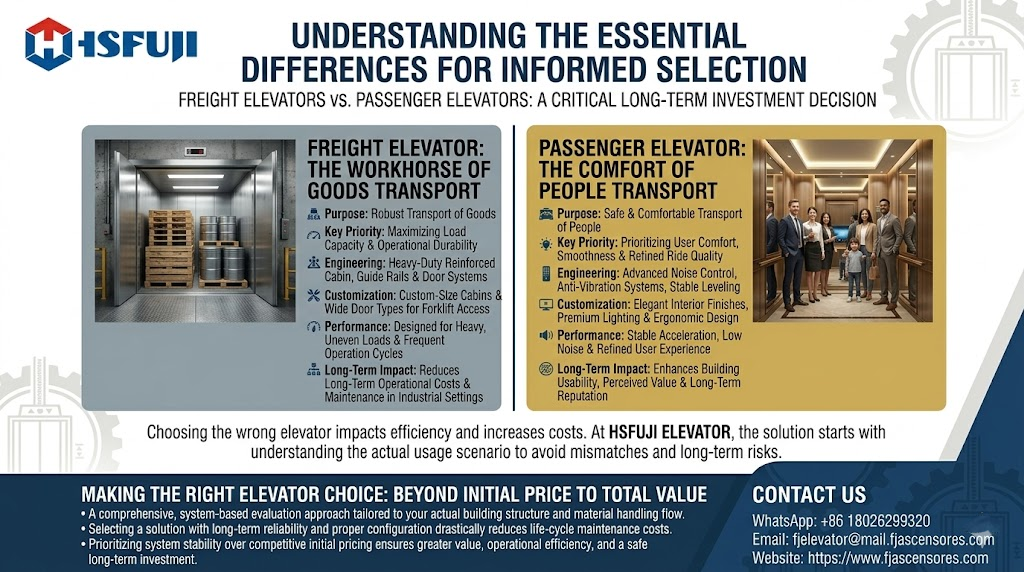
In some projects, a “universal” or lower-cost solution may seem attractive at first. However, in actual use, it can lead to inefficiencies, higher maintenance costs, or even the need for later modifications.
An elevator is a long-term investment rather than a short-term purchase. Selecting a solution that truly fits the application will provide greater value over time.
HSFUJI ELEVATOR is committed to delivering tailored solutions based on real project needs. Although this approach may require more detailed communication in the early stage, it ultimately ensures a more reliable, efficient, and cost-effective result for the client.
 Does Installing a Home Elevator Really Increase Property Value?