Home
Home HSFUJI
  Jan 06,2026
What Is a Home Lift?What’s the Difference Between a Home Lift and a Home Elevator?
As multi-story houses, duplex apartments, and private villas become more common, more families are looking for easier and safer ways to move between floors. During this process, two terms often appear together: “home lift” and “home elevator.”
Are they the same product? Or do they serve different purposes?
This article explains the differences clearly—from definition and structure to application scenarios and selection tips—helping you choose the solution that truly fits your home.
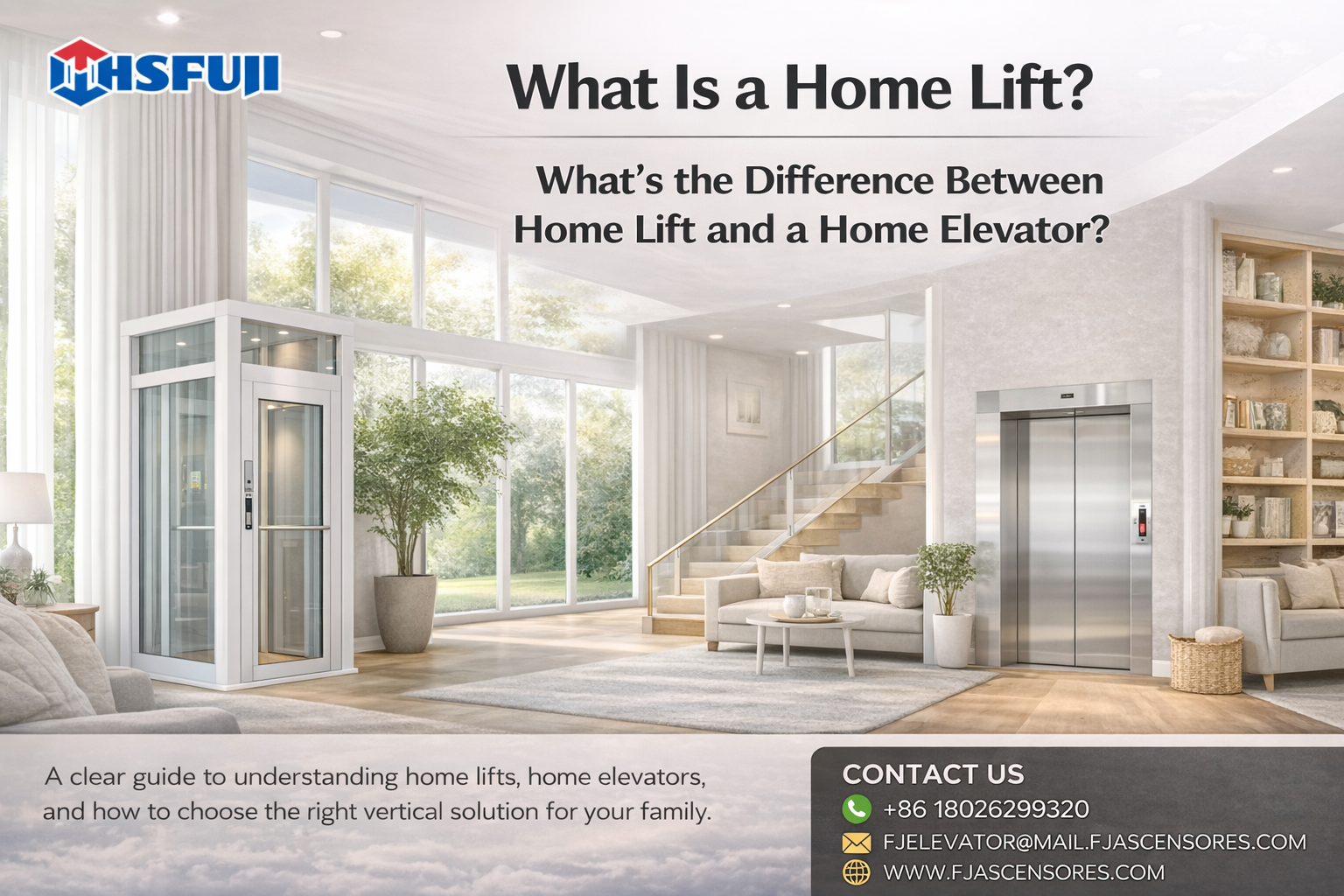
1. What Is a Home Lift?
A home lift is a vertical lifting device designed specifically for residential use. Its primary users are family members, not public traffic, which makes its design logic very different from commercial elevators.
From the beginning, home lifts focus on:
Typical household usage frequency
Limited residential space conditions
Safety and riding comfort
Installation flexibility and visual integration
Common types of home lifts include:
Platform home lifts
Screw-driven home lifts
Compact traction-based residential systems
Among these, platform home lifts are especially popular due to their simple structure, strong space adaptability, and suitability for home renovations and retrofitting projects.
2. What Is a Home Elevator?
Home elevator is a broader term that generally refers to any elevator system installed in a residential environment.
In real-world applications, a home elevator can be:
A downsized version of a commercial traction elevator
Or a residential-only lifting system developed for home use
Therefore, home elevator mainly describes where the elevator is used, while home lift emphasizes how the product is designed and engineered.
3. Key Differences Between Home Lifts and Home Elevators
Although the names are often mixed, there are clear differences in design philosophy, structure, and installation requirements.
Comparison Table
Comparison Aspect | Home Lift | Home Elevator |
Design Purpose | Designed specifically for family and residential use | General term for elevators installed in homes |
Typical Structure | Platform-type or screw-driven systems | Mostly compact traction elevator systems |
Shaft & Pit Requirements | Can be shaft-less or use a shallow pit | Usually requires a dedicated shaft and pit |
Space Adaptability | Very flexible, suitable for small or irregular spaces | Higher space and structural requirements |
Installation Scenarios | New homes, renovations, retrofits, and upgrades | Mainly planned during new villa construction |
User Experience | Simple operation, smooth movement, family-oriented safety | Closer to traditional commercial elevator experience |
Maintenance Needs | Lower maintenance complexity, easy daily management | Maintenance similar to standard elevator systems |
In simple terms:
A home lift feels like a lifting solution custom-made for your home.
A home elevator feels more like a traditional elevator adapted for residential use.
4. Which Families Are Better Suited for a Home Lift?
A home lift is not a “lower-level option”—it is a more residential-oriented solution, especially suitable for:
Homes without enough space for a standard elevator shaft
Renovated or already-finished houses
Families with elderly members, children, or people with limited mobility
Homeowners who want the lift to blend naturally with interior design
Users who value easy operation and low long-term maintenance
With proper structural design and safety configurations, home lifts can offer stable, reliable, and long-term performance.
5. How to Choose the Right Solution for Your Home?
Instead of focusing on product names, homeowners should consider these practical questions:
Is there a pre-reserved elevator shaft in the house?
How many people will use it, and how frequently?
Do you value space efficiency or a traditional elevator experience more?
Are long-term maintenance and energy consumption important factors?
A professional residential lift provider will evaluate your house structure, usage needs, and budget, then recommend either a home lift or a home elevator system that best matches your situation.
6. Conclusion: Different Names, Same Goal—Designed for Family Living
Whether it’s called a home lift or a home elevator, the core purpose remains the same:
To make moving between floors safer, easier, and more comfortable for everyday family life.
What truly matters is not the terminology, but whether the solution:
Fits your home’s structure
Matches your family’s long-term usage needs
Choosing a lift system designed specifically for your home means investing not just in a device—but in a more comfortable, secure, and future-proof lifestyle.
 Hydraulic vs. Traction Elevators: Which Home Elevator Is More Cost-Effective?