Home
Home HSFUJI
  Mar 20,2026
4 Hidden Costs You Should Know Before Buying a Home Elevator (The Real Truth)
When deciding to add a home elevator to your villa or custom-built house, your first reaction is usually to request quotes from various brands. You might receive several seemingly attractive initial quotations, but before you sign and pay, we need to have an honest conversation: Is the quote you see truly the final total budget you will pay?
Unlike ordinary home appliances, a home elevator is a highly customized architectural project. Many homeowners are surprised to find their budgets severely overrun during installation or after putting it into use. To help you avoid these pitfalls, we have broken down the top four hidden costs most easily overlooked before buying a home elevator.
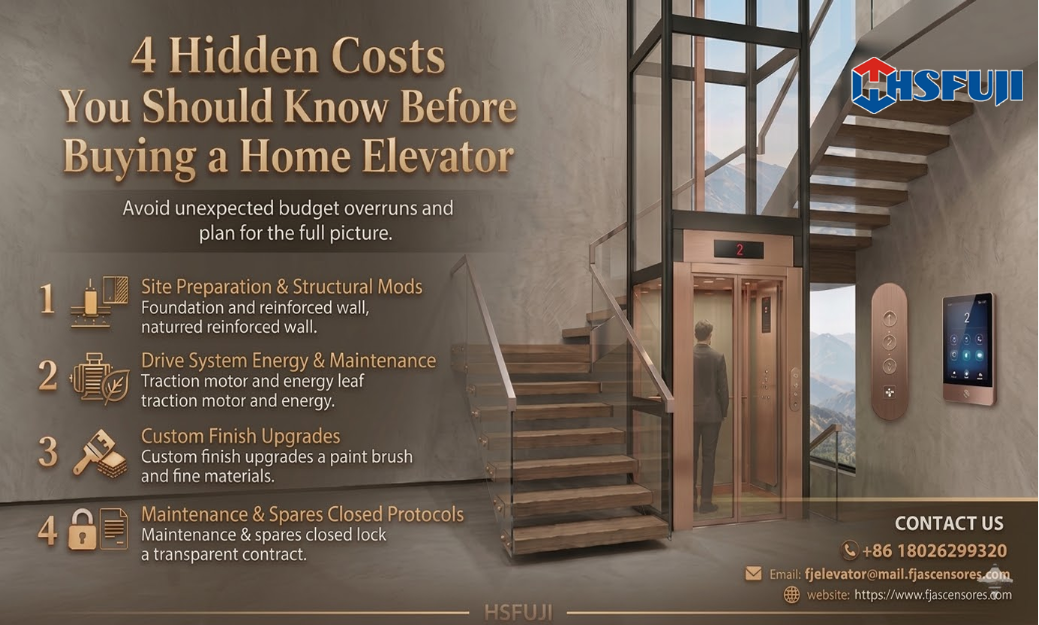
1. Civil Works and Shaft Modification Costs: The Biggest "Budget Blind Spot"
This is the number one reason for budget overruns in elevator projects. The equipment quote usually only includes the elevator itself, excluding any structural modifications to the house.
Pre-existing Standard Shaft: If your villa was designed with a standard-sized elevator shaft during initial construction, and the pit depth and overhead height meet requirements, the hidden costs here are almost zero.
No Pre-existing Shaft (Retrofitting): If the installation requires cutting through floor slabs, modifying stairs, or building a new independent high-strength steel or aluminum alloy shaft outdoors (even involving foundation waterproofing), the cost of civil works and the new shaft will take up a significant portion of the overall budget. In some complex retrofitting projects, this expense might even equal the cost of the elevator equipment itself.
The Real Advice: When comparing quotes, make sure a professional engineer conducts an on-site evaluation to clarify the scope of civil works and estimated costs. Do not let the "pure equipment base price" mask high construction costs.
2. The "Long-Term Bill" of the Drive System: Cheap to Buy, Expensive to Use
Elevators with different drive systems (such as traction, hydraulic, or screw-driven) differ not only in their initial purchase price but also drastically in their hidden costs regarding service life, daily energy consumption, and post-sales maintenance.
Choosing the Right Technology: While top-tier modern hydraulic or screw technologies have specific applications in highly restricted spaces, in frequently used modern villas, they may face limitations in running speed and higher long-term maintenance costs.
The Optimal Long-Term Solution: Currently, mid-to-high-end residences tend to prefer Machine-Room-Less (MRL) traction systems. Although the initial equipment investment might be slightly higher, they operate extremely smoothly and quietly, with significant energy-saving effects. This can drastically reduce electricity bills and the cost of frequent parts replacement for the next ten or even twenty years.
3. Custom Design Upgrades: The Price Gap from "Standard" to "Luxury"
Initial quotes are often based on the most basic "standard configuration" (e.g., standard painted steel cabins, standard lighting). However, an elevator that truly integrates into modern villa design usually requires a high degree of customization. Once you start pursuing a visual effect that perfectly matches your home's style, hidden costs will increase:
Material and Color Upgrades: Upgrading to premium metal finishes like champagne gold, rose gold, or brushed silver, or adopting a minimalist design with cream tones and natural wood grains, all require higher material and craftsmanship costs.
Panoramic Glass Cabins: Opting for a three-sided panoramic glass cabin involves more than just the cost of the glass itself. It requires upgrading the shaft's structural strength and using concealed wiring and specialized safety components for panoramic elevators to ensure ultimate visual purity and absolute running safety.
These are worthwhile visual investments, but they need to be clearly planned into the overall budget at the very beginning of the project.
4. The "Locked-In" Post-Sales Maintenance and Parts Costs
This is a favorite trick of many ultra-low-priced elevator suppliers. Some brands attract customers with extremely low upfront prices, only to earn back their profits over decades of use through expensive proprietary spare parts and high call-out service fees.
Beware of Closed Protocols: If the elevator's motherboard or core components use a "closed protocol," it means you will be forced to buy high-priced spare parts directly from the original manufacturer in the future, losing the right to freely choose a maintenance company in the open market.
Transparent Commitments: An excellent supplier will provide transparent warranty terms, a standardized parts supply system, and clear estimated annual maintenance costs, giving you peace of mind in both daily use and long-term repairs for decades to come.
Make Every Cent of Your Investment Clear
An excellent villa elevator brings long-lasting safety and convenience to the whole family and serves as an important asset that boosts property value. Understanding these hidden costs is not meant to discourage you from installing one, but to help you grasp the big picture during the early planning stages and avoid the awkwardness of budget overruns later.
Do not be blinded by a single price tag. When choosing a home elevator, what you are truly purchasing is a vertical mobility solution that perfectly matches your building's structure.
At HSFUJI ELEVATOR, we insist on providing transparent, custom solutions with zero hidden costs. We don't just sell equipment; we focus on delivering a stable vertical mobility solution that matches your building's structure and integrates seamlessly with your interior aesthetics.
Ready to get a real, professional elevator solution?
Simply share your floor plan, number of floors, or site photos with us, and we will provide preliminary solution recommendations and a reasonable budget range within 24 hours.
WhatsApp: +86 18026299320
Email: fjelevator@mail.fjascensores.com
Website: https://www.fjascensores.com
 Is a Cheap Home Elevator Really Worth the Risk?