Home
Home HSFUJI
  May 20,2026
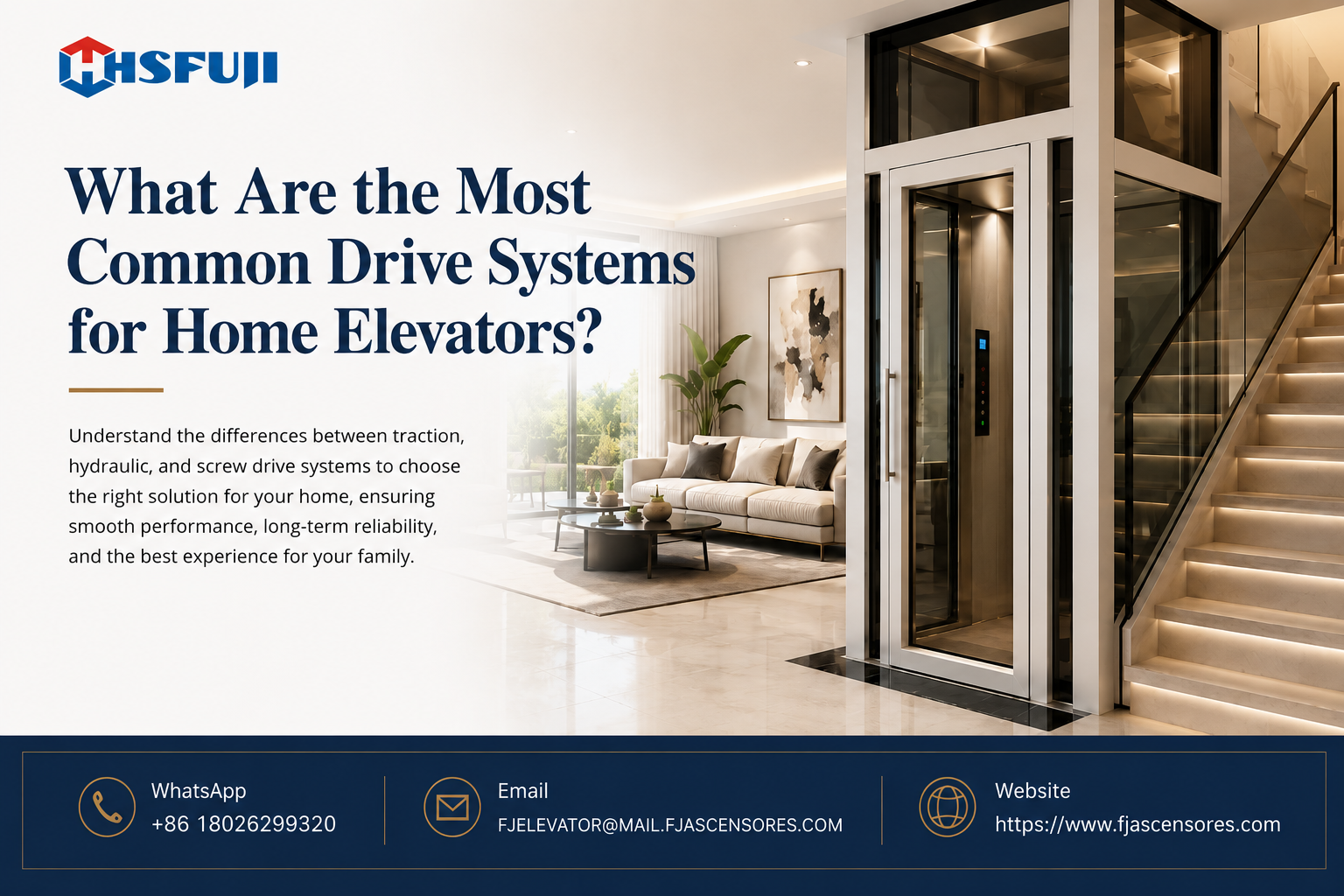
What Are the Most Common Drive Systems for Home Elevators?
With the increasing number of modern villas and multi-story residences, a home elevator is no longer a luxury but an essential part of daily life. When planning an elevator installation, many families tend to focus on appearance, dimensions, or price, while overlooking the core factor: the drive system. The drive system directly impacts the elevator's smoothness, quietness, comfort, and long-term maintenance costs. Therefore, understanding the characteristics of different systems is crucial.
Currently, the most common drive systems for home elevators on the market are traction, hydraulic, and screw-driven. Each system differs in operational logic, space requirements, user experience, and ease of maintenance, making them suitable for different types of homes and family needs.
Traction Home Elevators: The Mainstream Choice for High-End Villas
Traction home elevators use a traction machine, steel ropes, and a counterweight system to raise and lower the cabin. This technology is highly mature and operates with exceptional stability. Modern Machine Room-Less (MRL) traction technology significantly reduces space requirements, making it adaptable to a wider variety of home structures.
In practice, owners of three-story and higher villas often prefer traction systems. They perform smoothly under high-frequency daily use, consume less energy, and offer more controllable maintenance costs. HSFUJI ELEVATOR further optimizes operational logic and vibration control in our designs, ensuring quiet, fluid movement over long-term use and enhancing the family's everyday experience.
Hydraulic Home Elevators: Suited for Low-Rise Homes and Retrofits
Hydraulic elevators operate primarily using a hydraulic cylinder to drive the cabin. They offer strong structural adaptability, making them particularly advantageous for retrofit projects in older homes or where shaft space is restricted. Hydraulic systems provide good operational stability for low-rise homes or duplex apartments, with flexible and relatively straightforward installation.
However, in multi-story homes or high-frequency environments, hydraulic systems can come with trade-offs, including higher energy consumption, increased noise levels, and the need for frequent hydraulic oil maintenance. Therefore, for villa owners seeking long-term stability and premium comfort, hydraulic elevators are often viewed more as a solution for specific, limited scenarios.
Screw-Driven Home Elevators: A Compact Solution for Small Spaces
Screw-driven elevators use a screw and nut mechanism to move the cabin. They feature a highly compact structure and require minimal shaft space, making them ideal for residences with ultra-compact layouts. Some projects can even be installed without a pit, offering maximum installation flexibility.
The trade-off is that these systems generally operate at slower speeds, and their comfort and acoustic performance may be limited under high-frequency use. As a result, they are typically utilized in two-story duplexes, small retrofit projects, or homes with low usage frequency. For multi-story villas demanding a high-end, comfortable experience, traction systems remain the more dependable choice.
The Importance of the Drive System
In the past, families focused mostly on whether an elevator could be installed. Today, the long-term user experience is the critical consideration. The drive system is directly tied to the elevator’s stability, comfort, noise control, energy efficiency, and future maintenance convenience. Choosing a system that fits your home's structure and your family's needs is far more important than merely comparing initial prices.
Professional Advice from HSFUJI ELEVATOR
At HSFUJI ELEVATOR, we look beyond simple product specifications; we prioritize your family's daily experience. Based on your villa's floor height, shaft conditions, and family profile, we provide tailored recommendations for the optimal drive system. This ensures not only a smooth installation but also stable, long-term operation. Whether it's a traction, hydraulic, or screw system, the ultimate goal is to ensure that your entire family enjoys a safe, comfortable, and natural ride for decades to come.
Choose the Right System to Secure Long-Term Value
There is no absolutely "best" drive system—only the one that best suits your family's specific needs. The right choice ensures that the elevator remains stable, quiet, and safe throughout years of operation while reducing long-term maintenance costs. For every family that values quality of life, understanding the advantages and appropriate applications of different drive systems is the key to maximizing the long-term value of a home elevator.
 Why More Families Are Paying Attention to the Long-Term Cost of Home Elevator Maintenance