Home
Home HSFUJI
  Jan 29,2026
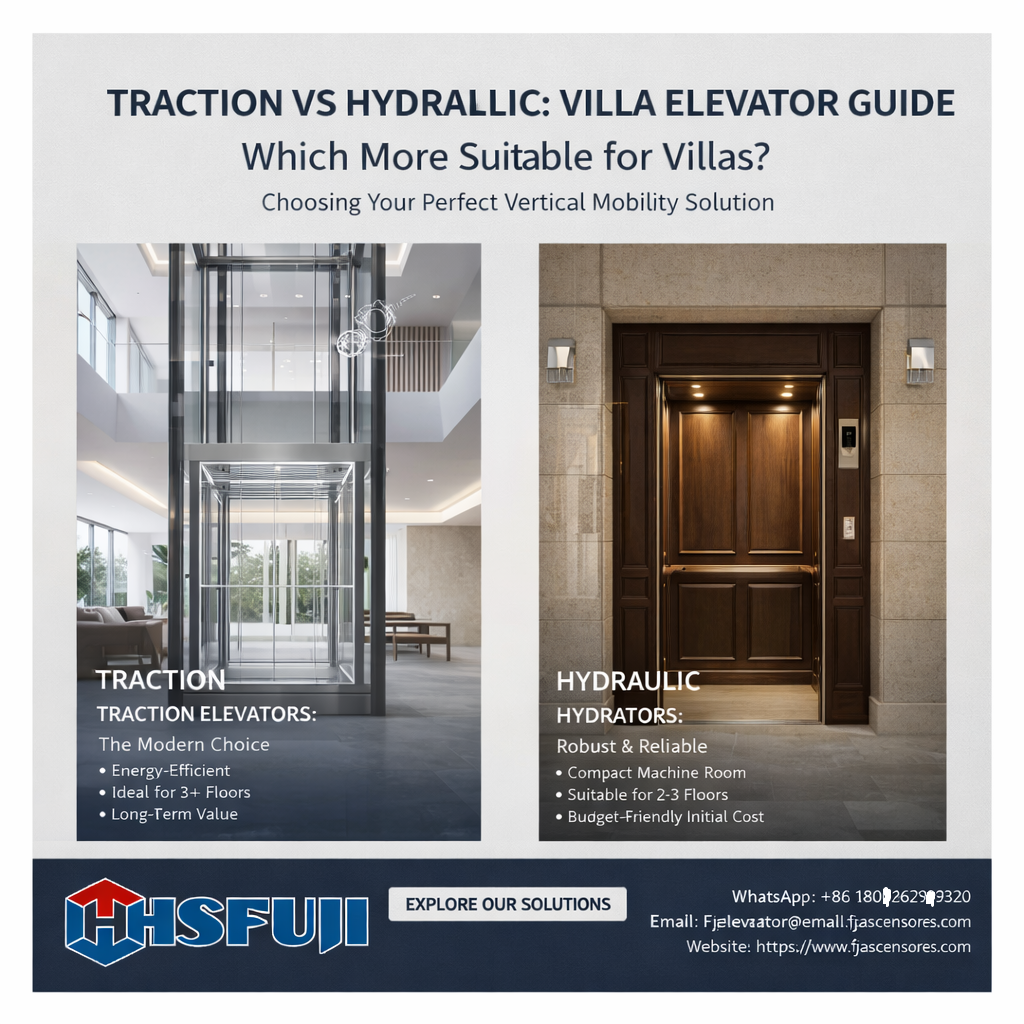
Traction vs. Hydraulic Elevators: Which Is More Suitable for Villas?
In villa planning, home elevators are no longer about whether to install one, but about choosing a solution that truly fits long-term living. As multi-story residences and high-end villas become increasingly common, elevators have gradually become an essential element for improving daily comfort and enhancing property value. Different elevator types vary significantly in structure, user experience, and long-term operating costs.
Among the various home elevator options, traction elevators and hydraulic elevators are the two most frequently compared systems. Many homeowners struggle with questions such as which one is more stable, which is more cost-effective, or which one appears more “premium.” In reality, the most suitable elevator for a villa is determined less by appearance and more by the building structure and the household’s actual usage needs.
Understanding Elevator Selection from a Villa Living Perspective
What distinguishes a villa from ordinary residential buildings is its longer occupancy cycle, greater number of floors, and higher usage frequency. An elevator is not merely a tool for moving between levels, but a system that becomes part of daily family life over many years. As a result, operational stability, ride comfort, and long-term maintenance costs are often more important than the initial purchase price.
A truly suitable villa elevator should remain smooth, quiet, and reliable over years of use, without disrupting the living environment. This is precisely why the differences between traction and hydraulic elevators are frequently discussed in villa projects.
Advantages of Traction Elevators in Villas
Traction elevators operate through a motor, steel ropes, and a counterweight system. This mature technology is known for its efficiency and stable performance. In villa applications, its advantages are most evident in everyday user experience, including smoother starts and stops and better noise control.
For families planning long-term residence, traction elevators are generally more energy-efficient, helping to keep electricity consumption and maintenance costs under control over time. In villas with three or more floors, the benefits of traction systems become even more apparent in terms of operational efficiency and stability. They are well suited for frequent use and for homeowners who place a high value on comfort and overall quality.
When Are Hydraulic Elevators a Suitable Option?
Hydraulic elevators operate by using a hydraulic pump to drive a piston system, resulting in a relatively simple mechanical structure. Under certain conditions, hydraulic elevators can still be a practical choice. For example, they may be suitable for villas with fewer floors, lower usage frequency, or renovation projects where structural conditions are limited.
From an initial investment perspective, hydraulic elevators can be easier to fit within a controlled budget, making them attractive for specific projects. However, from a long-term usage standpoint, hydraulic systems differ from traction elevators in terms of energy consumption, maintenance frequency, and ride comfort. This is why, in high-end villa projects, hydraulic elevators are more often considered a solution for specific scenarios rather than a universal choice.
Choosing a Villa Elevator Is Not Just About Price
In real projects, many homeowners focus first on price when selecting an elevator. Yet in a villa setting, an elevator is a long-term investment, often expected to operate reliably for ten years or more. Comparing only the initial cost can easily overlook long-term operating expenses and user experience.
Factors such as the presence of elderly family members or children, plans for long-term residence, and ease of future maintenance all need to be considered. A truly suitable villa elevator should remain stable and reliable over time, rather than saving costs in the short term while creating greater burdens in the long run.
The Selection Philosophy of HSFUJI ELEVATOR
At HSFUJI ELEVATOR, we do not simply recommend one elevator type over another. Instead, we evaluate each project based on the villa’s architectural structure and the household’s actual needs. Shaft conditions, floor height, and usage frequency all play a critical role in determining the most appropriate system.
Whether choosing a traction or hydraulic elevator, our focus is on how well the system integrates with the building and how it performs in terms of long-term safety and stability. Through thoughtful system planning and customized design, we ensure that the elevator becomes a natural part of the villa, rather than a compromise added later.
Which Elevator Is Right for Your Villa?
There is no absolute “better” or “worse” between traction and hydraulic elevators. What truly matters is whether the system matches the villa’s structure and the family’s living requirements. For most multi-story villas intended for long-term residence, traction elevators offer clear advantages in comfort and long-term value. Under specific conditions, however, hydraulic elevators can still fulfill their intended role effectively.
Choosing a villa elevator is, in essence, a decision about your future lifestyle. A solution that truly fits your needs is often far more valuable than one that simply appears cheaper at first glance.
 Where Does the Cost of a Home Elevator Really Go?