Home
Home HSFUJI
  May 06,2026
The Ultimate Guide to Villa Elevators: Hydraulic vs. Traction — Which One Should You Choose?
When planning a custom elevator for your dream villa, many homeowners initially focus on design and how well it fits the space. However, over the long term, what truly impacts comfort and maintenance costs is a more fundamental factor — the choice of drive system.
In today’s home elevator market, the two most common technologies are Hydraulic Elevators and Traction Elevators. They differ significantly in working principles, user experience, and long-term maintenance.
Understanding these differences will help you make a more rational decision — one that delivers lasting value over time.
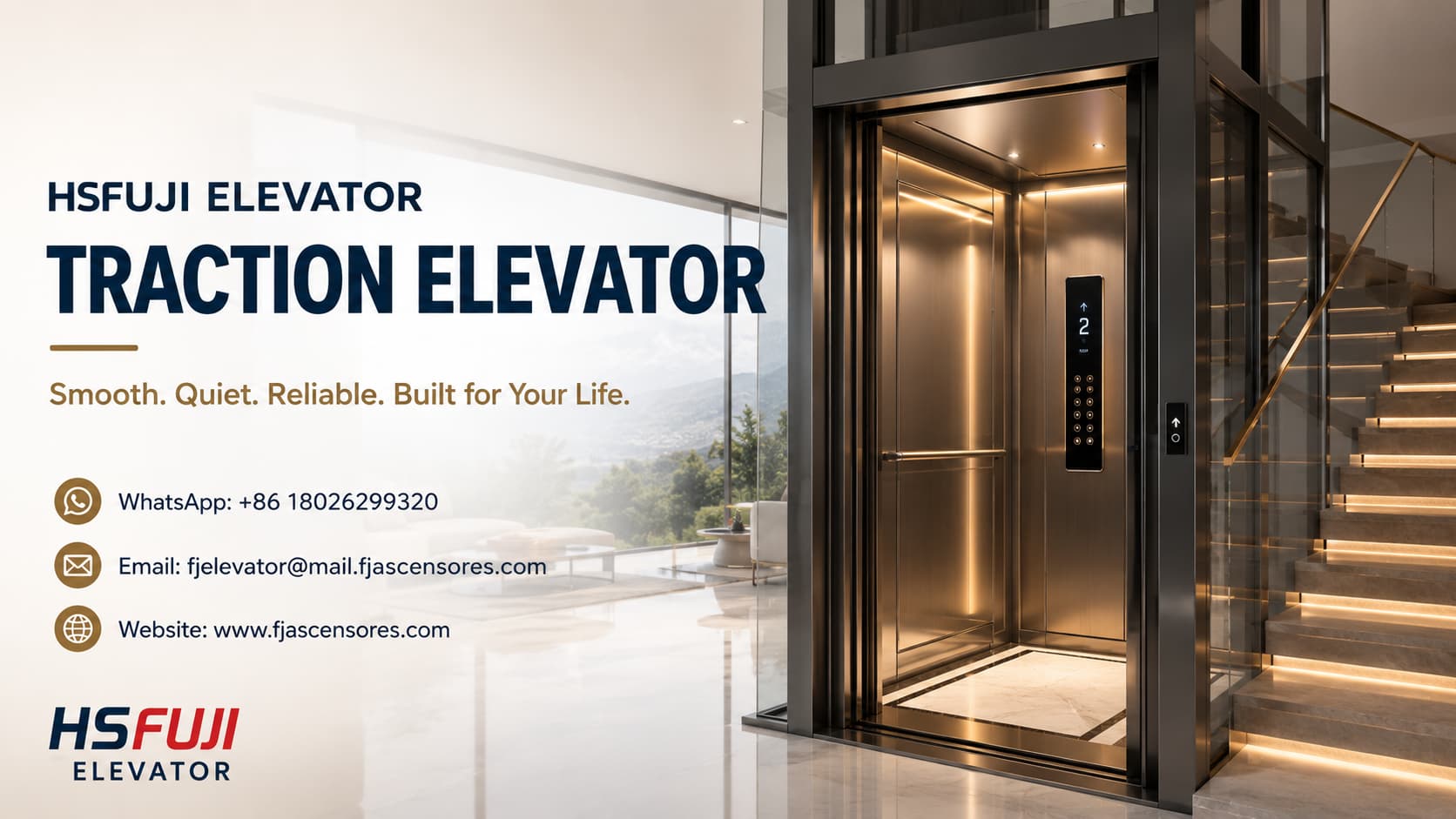
Hydraulic Elevators: A Mature and Reliable Traditional Solution
Hydraulic elevators operate by pumping hydraulic oil into a cylinder, pushing a piston to move the elevator car vertically. This technology has been used for decades and continues to perform reliably in specific applications.
Where They Perform Well
Hydraulic systems excel in heavy-load scenarios, which is why they are still widely used in freight elevators and projects requiring high lifting capacity. In addition, for buildings with limited overhead space, hydraulic elevators can offer certain structural advantages.
Practical Considerations
Over long-term use, hydraulic systems require a relatively high level of maintenance. If seals age or maintenance is insufficient, there may be a risk of oil leakage, which can increase maintenance costs and affect the cleanliness of the shaft environment.
Compared to modern traction systems, hydraulic elevators also face greater challenges in noise control, particularly during pump operation. Additionally, the physical properties of hydraulic oil are sensitive to temperature changes, which in some climates may slightly affect ride smoothness.
For these reasons, hydraulic elevators are better suited for specific functional needs, while their use in high-end residential environments has gradually become less common.
Traction Elevators: The Mainstream Choice for Modern Villas
Traction elevators use a motor to drive steel ropes or belts, with one end connected to the car and the other to a counterweight. By leveraging physical balance, they achieve efficient and stable operation. This is currently the most widely used elevator technology worldwide.
Key Advantages
In terms of ride quality, traction elevators equipped with permanent magnet synchronous gearless motors significantly reduce mechanical noise and vibration, resulting in smoother and quieter operation. This is especially important in residential settings, where quiet performance enhances everyday comfort.
From an environmental and maintenance perspective, traction systems do not require hydraulic oil, eliminating the risk of leakage and odors, making them more suitable for long-term integration into living spaces.
In terms of energy efficiency, the counterweight system offsets most of the load, meaning the motor only needs to overcome a small load difference and friction. Under typical residential usage conditions, traction elevators generally offer better energy performance than traditional hydraulic systems.
They also provide higher efficiency and more stable speed performance, making them well-suited for frequent daily use.
How to Choose: Beyond Functionality to Long-Term Experience
From a purely functional perspective, both systems can fulfill the basic requirement of vertical transportation. However, when considering a usage period of 10, 15, or even more years, the differences become increasingly noticeable.
For private villas, duplex homes, or high-end residences, an elevator is not just a piece of equipment — it becomes part of daily life. Noise levels, air quality, and maintenance predictability all directly influence the living experience.
In most high-end residential projects, traction elevators are generally considered a more balanced solution with stronger long-term value. That said, the optimal choice ultimately depends on the building structure, usage frequency, and overall project requirements.
HSFUJI ELEVATOR: Making Traction Technology Truly Residential-Friendly
At HSFUJI ELEVATOR, we focus not only on the elevator itself, but on how it performs in real daily living. Based on this philosophy, our villa elevators are built entirely on Machine Room-Less (MRL) traction technology, carefully optimized for residential applications.
More Flexible Space Adaptation
Under standard construction conditions, the MRL structure significantly improves space efficiency by eliminating the need for a traditional machine room. At the same time, it optimizes requirements for overhead height and pit depth, making it easier to integrate into a wide range of villa designs.
Greater Safety and Peace of Mind
Our systems come standard with high-sensitivity light curtain protection and an Automatic Rescue Device (ARD). In the event of a power outage, the elevator can safely move to the nearest floor, ensuring passenger safety. The system is also designed in compliance with mainstream international elevator safety standards (such as EN81 or equivalent).
Designed for Living, Not Just Function
From materials and lighting to color and detail, we offer a wide range of customization options. The elevator becomes more than a functional device — it becomes a natural extension of your interior space and a seamless part of your home.
Choosing an elevator is, in essence, choosing a long-term lifestyle experience.
The best solution for any project depends on its specific usage scenario and design conditions. When an elevator is used every day, factors like quiet operation, smooth performance, and reliability matter far more than technical specifications alone.
Compared to short-term cost considerations, long-term comfort and stability are what truly define value.
CONTACT US
WhatsApp: +86 18026299320
Email: fjelevator@mail.fjascensores.com
Website: https://www.fjascensores.com
 A Decades-Long Promise to Your Family: What Is the True Lifespan of a Villa Elevator?