Home
Home HSFUJI
  Sep 05,2024
1. Overview of Moving Walkways
Moving walkways, as an essential part of modern transportation systems, are electromechanical devices designed to transport people in a horizontal or slightly inclined direction using a continuously moving conveyor structure. Their primary function is to alleviate pedestrian traffic congestion in public spaces and improve spatial efficiency. These systems typically consist of drive mechanisms, load-bearing structures, safety protection devices, and control systems, serving as an alternative to traditional walking paths in specific environments.
2. Classification and Characteristics
(A) Classification by Transport Form
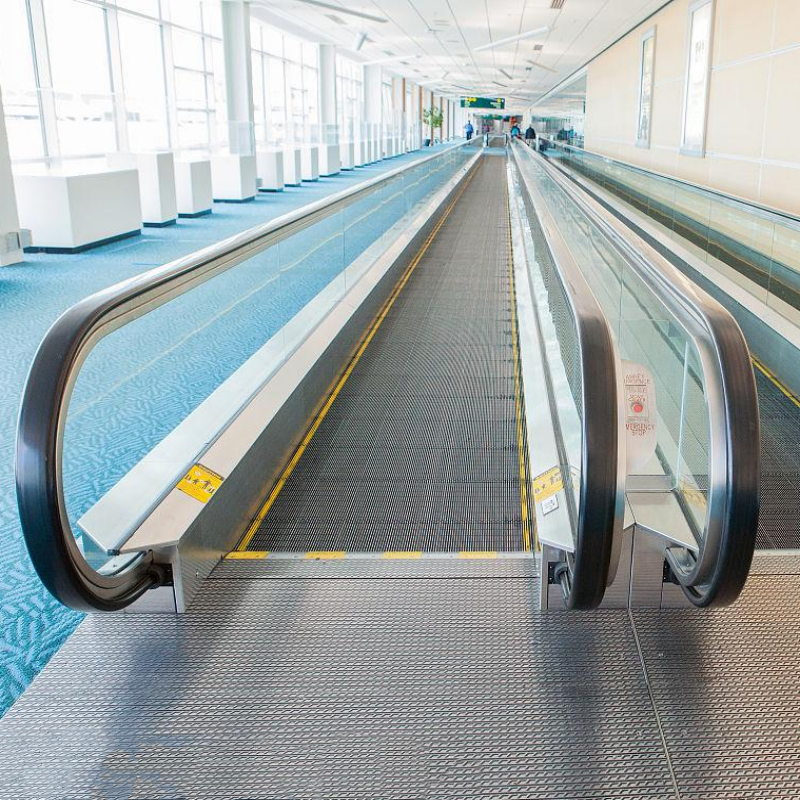
Horizontal Moving Walkway
Inclination: 0° - 12°
Typical Applications: Airport terminals, railway station transfer zones
Technical Features: Uses parallel roller support structure to ensure passenger stability
Slightly Inclined Moving Walkway
Inclination: 12° - 15°
Suitable for: Connecting floors in large shopping malls, linking subway platforms
Structural Features: Equipped with anti-slip treads and synchronized handrail systems
Spiral Moving Walkway
Designed for unique spatial solutions
Typical Use Cases: Circular exhibition areas in museums, vertical transportation in commercial complexes
Technical Challenges: Requires precise control of curvature radius and operating speed
(B) Classification by Load Capacity
Light-duty system: Rated transport capacity ≤ 5,000 people/hour
Medium-duty system: Rated transport capacity between 5,000-8,000 people/hour
Heavy-duty system: Rated transport capacity ≥ 8,000 people/hour
3. Key Technical Solutions
(A) Drive Systems
Chain Drive Technology
Uses double-row roller chain transmission
Advantages: High load capacity, low maintenance costs
Suitable for: Heavy-duty moving walkways
Belt Drive Technology
Utilizes specially designed rubber composite conveyor belts
Advantages: Low noise operation, ideal for environments with strict noise control requirements
(B) Safety Protection Systems
Multi-layer Braking System
Combination of electromechanical and electromagnetic brakes
Braking response time ≤ 0.3 seconds
Intelligent Monitoring System
Integrated vibration and temperature sensors
Enables real-time fault diagnosis and early warning detection
Emergency Stop Mechanism
Manual emergency stop buttons placed every 15 meters along the system
Automatic obstacle detection triggering system
(C) Material Engineering
Tread Materials
High-strength aluminum alloy extrusion profiles
Surface treatment: Anti-slip coating and wear-resistant treatment
Handrail Materials
Multi-layer composite rubber structure
Fire resistance rating meets B1 standard
4. Typical Application Scenarios
(A) Transportation Hubs
Airport Terminals: Connecting boarding gates with security checkpoints
High-speed Railway Stations: Facilitating rapid transit between platforms and exits
Subway Systems: Linking different transfer corridors
(B) Commercial Facilities
Large Shopping Centers: Connecting multiple floors of commercial areas
Theme Parks: Managing high-density pedestrian traffic
(C) Public Buildings
Hospitals: Linking inpatient and outpatient departments
Stadiums: Facilitating crowd dispersion after events
(D) Special Scenarios
Tourist Attractions: Connecting scenic spots and walkways
Industrial Facilities: Enabling personnel transportation within production areas
5. Technological Development Trends
Energy-saving Technology
Application of variable frequency speed control systems can reduce energy consumption by over 30%
Energy recovery devices enable power reuse
Intelligent Upgrades
Facial recognition passenger flow analysis system
Adaptive speed regulation technology
New Material Applications
Lightweight carbon fiber composite treads
Self-cleaning coating for handrails
The selection of moving walkway systems should consider factors such as usage environment, passenger flow, and installation space. It is recommended that professional technical teams handle the system design and integration. In practical applications, a well-established maintenance plan should be implemented to ensure long-term stable operation.
 Types Of Elevators And Applications