Home
Home HSFUJI
  Apr 20,2026
How to Choose a High-Value Villa Elevator: Why Regret is More Common Than Overpaying
In our experience with villa elevator projects, we frequently encounter a familiar scenario: clients compare numerous proposals, analyze prices meticulously, and make what appears to be a highly "rational" decision. Yet, a year after moving in, a common sentiment emerges: "If I had known a little more back then, I would have made a better choice." The problem usually isn't that they made a "wrong" choice, but rather that the crucial differences between systems are incredibly difficult to truly grasp before installation.
A Real-World Case: Does "Cheaper" Actually Save You Money?
One of our clients building a custom villa initially opted for a lower-priced elevator package. His reasoning was straightforward: the elevator would just be an auxiliary convenience, usage would be low, and there was no need to overinvest.
However, reality shifted once the family moved in. With elderly family members in the home, the elevator quickly became a daily necessity, with usage frequency far exceeding his initial expectations.
About six months later, the subtle differences began to show. The mechanical noise was much more noticeable in a quiet home environment; the overall energy consumption was higher than anticipated due to the frequent trips; and occasional minor glitches made him start worrying about system stability. While none of these issues meant the elevator was "unusable," they became daily, magnified annoyances. When looking back at the alternative options he had rejected, he shared a very honest realization: "For something you use every single day, price shouldn't be the only deciding factor."
The True Meaning of Cost-Effectiveness: It's About the Years Ahead, Not the Moment of Purchase
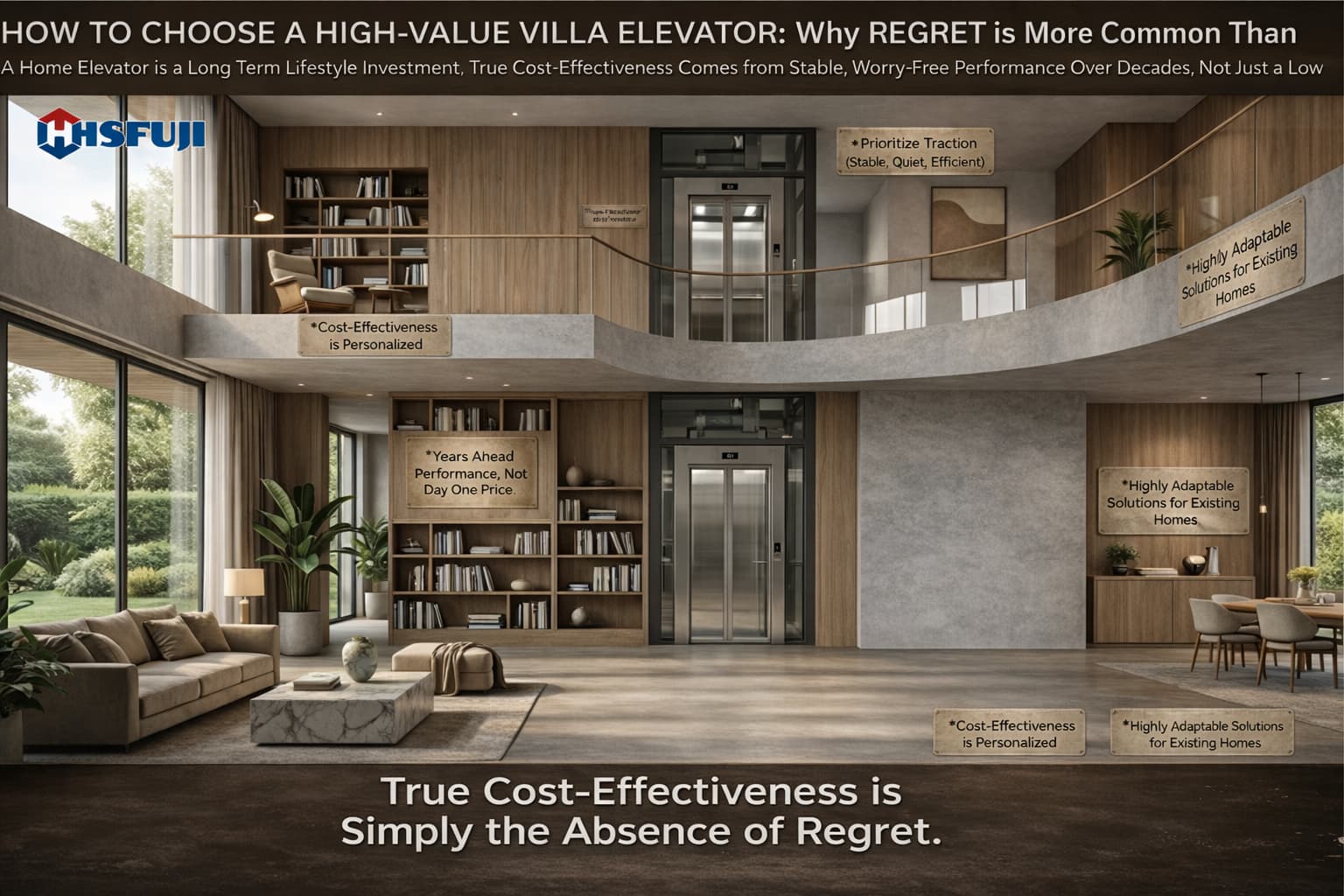
It is completely natural that a buyer’s first focus is the initial quote. But what truly dictates your living experience is how that elevator performs over the next few years, or even decades. The real cost of a home elevator isn't just the purchase price; it includes long-term energy consumption, maintenance frequency, system stability, and the daily comfort of the ride.
When viewed over a longer timeline, a "cheap" elevator is often only cheap on day one. A genuinely cost-effective solution is one that remains stable, worry-free, and doesn't create hidden financial or emotional burdens throughout its lifespan.
Why More Projects Are Prioritizing Traction Elevators
In recent years, we’ve noticed a clear trend: whenever building conditions permit, an increasing number of clients are prioritizing traction elevator systems. This isn't about upselling; it's because, over the long term, traction systems consistently deliver higher satisfaction regarding ride smoothness, energy efficiency, and overall operational stability.
Particularly in owner-occupied villas, these advantages aren't immediately obvious on installation day, but they amplify with every daily ride. That is why, for new residential builds, the HSFUJI ELEVATOR team typically recommends traction systems as the most rational choice for a superior long-term experience.
However, "Higher Specs" Aren't Always the Right Answer
Of course, a "higher configuration" isn't the best fit for every project. If you are renovating an existing home or have strictly limited shaft space, a highly adaptable installation solution becomes far more practical and ultimately more cost-effective.
This is a nuance many buyers miss: cost-effectiveness is never a one-size-fits-all standard; it is deeply tied to your specific architectural conditions. A truly professional elevator solution doesn't just push the most expensive product; it finds the most suitable technical answer for your unique spatial constraints.
Where Do Those Price Differences Actually Come From?
When comparing elevator quotes, you will often notice significant price gaps. These differences are rarely visible on the surface. Instead, they hide in easily overlooked details: the quality of the drive system and core components, the stability of the control panel, the thoroughness of the safety features, and the professional caliber of the installation and commissioning teams.
These factors are nearly impossible to physically "see" upfront, but they will make themselves known, bit by bit, as the years go by. Therefore, when faced with varying prices, it pays to look past the final number and scrutinize these "invisible" elements.
A More Practical Way to Make Your Decision
If you are currently trying to choose, try asking yourself a question grounded in real life: Three years from now, will this elevator still make me feel like I made the right choice?
Once installed, a home elevator is rarely replaced. Yet, your experience of it will be magnified with every trip up and down. From this perspective, choosing an elevator is not just a procurement task; it is an investment in your future lifestyle.
Ultimately, Our Focus Goes Beyond the Price Tag
In our daily work at HSFUJI ELEVATOR, our primary concern isn't figuring out which quote is the cheapest. Our goal is to determine which solution will keep our clients completely satisfied for years to come. This is why we insist on explaining the critical differences upfront, rather than leaving our clients to discover them the hard way later on.
Choosing a home elevator is never a simple expense—it is a long-term lifestyle decision. Choose right, and it brings daily ease and peace of mind. Choose wrong, and it brings daily, magnified discomfort.
And true cost-effectiveness, at its core, is simply the absence of regret.
 Hydraulic vs. Traction Elevators: Why the Choice Isn’t Always Obvious