Home
Home HSFUJI
  Mar 03,2026
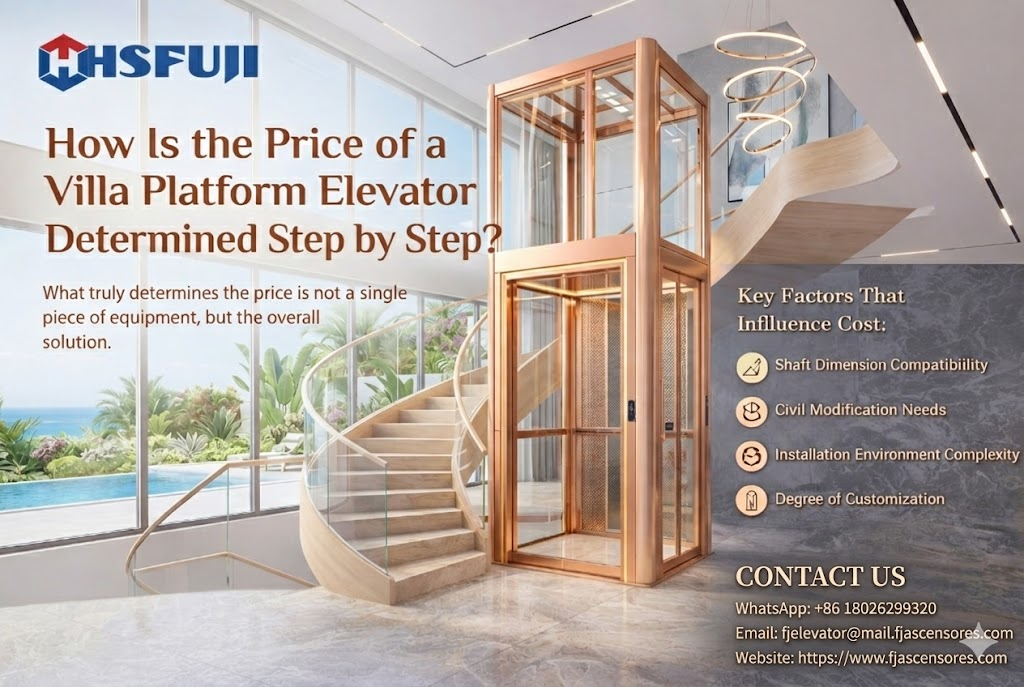
How Is the Price of a Villa Platform Elevator Determined Step by Step?
For many homeowners, the price of a villa platform elevator seems like it should fall within a fixed range. However, in real projects, pricing is rarely quoted as a single number from the beginning. Instead, it gradually takes shape as the technical solution becomes clearer.
Especially in villas with limited space, every design decision can influence the final budget.
What truly determines the price is not a single piece of equipment, but the overall solution.
Initial Budget and Site Conditions
A homeowner with a three-story private villa planned to install a platform elevator, with an initial budget aligned with mainstream standard configurations.
After on-site measurement, it was discovered that the clear shaft width was only 1100 mm, the staircase turning space was limited, and major structural demolition was not permitted.
If a standard-size elevator were used, part of the staircase would need to be removed and reinforced with additional steel structure. This would increase civil construction costs by approximately 18%–22% and extend the construction period by about three weeks.
At this point, the first budget divergence appeared.
Budget Changes Caused by Solution Comparison
Based on site conditions, two feasible solutions were proposed.
Option 1: Standard structure combined with partial civil modification.
The elevator equipment cost was lower, but after including structural renovation, the overall budget increased by about 20%.
Option 2: Customized narrow-body platform structure.
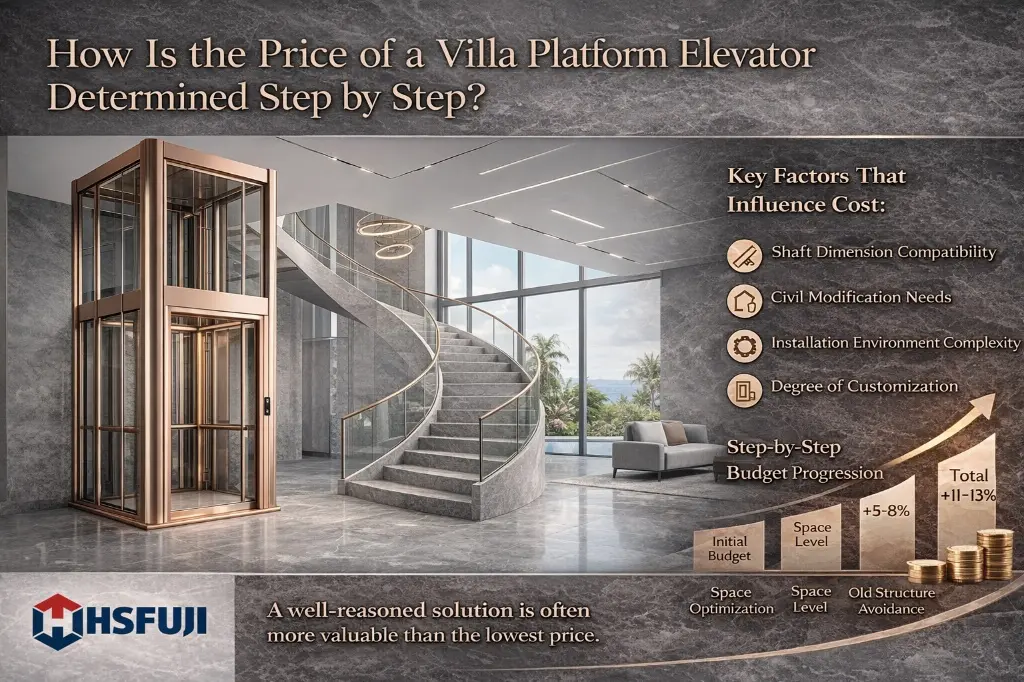
The equipment unit price increased by approximately 12%, but no structural demolition was required. The overall project budget increased by only 5%–8%.
After comprehensive evaluation, the homeowner realized that although the customized option had a higher unit price, it was more cost-effective in terms of total investment.
At this stage, price evaluation shifted from “equipment cost” to “overall investment.”
Drive System Selection and Long-Term Cost
A second budget adjustment occurred during drive system configuration.
The basic drive system met daily usage needs, while upgrading to a low-noise system increased equipment cost by approximately 6%–9%.
However, the upgraded system was expected to reduce maintenance frequency by about 15% and decrease operating energy consumption by 8%–10%.
Considering that villa elevators typically operate for more than 15 years, the homeowner focused more on long-term operational stability.
Ultimately, the decision was based on total cost of ownership rather than initial purchase price.
How the Final Budget Was Formed
After three rounds of solution confirmation, the final overall budget increased by approximately 11%–13% compared to the original expectation.
However, this adjustment avoided structural modification risks and reduced long-term maintenance pressure.
What the homeowner ultimately recognized was not the price itself, but the clear reasoning behind every cost adjustment.
Why Do Villa Platform Elevator Prices Vary So Much?
required、Drive system level、Installation environment complexity、Degree of customization.Any one of these factors may result in a 5%–25% cost variation.
This is the fundamental reason why villa platform elevator prices vary significantly in the market.
A More Rational Way to Evaluate Price
In the project practice of HSFUJI ELEVATOR, greater emphasis is placed on structural optimization and long-term cost control rather than simple price competition.
Through accurate early-stage measurement and multi-solution comparison, budget variations can be kept within a predictable range.
For homeowners who truly value residential quality, a well-reasoned solution is often more important than the lowest price.
 What Determines the Price of a Traction Home Elevator?