Home
Home HSFUJI
  Jan 04,2026
How Can an Elevator Become “Invisible” in a Small Space?
In many villas, duplex homes, and renovation projects, limited space is often the biggest concern when homeowners consider installing a home elevator.
“Will an elevator make the house feel crowded?”
“Will it disrupt the original interior design?”
In fact, with the continuous advancement of home elevator technology and design concepts, elevators no longer need to compete for space. Through thoughtful structural planning and refined design optimization, a home elevator can seamlessly integrate into the living environment—sometimes becoming almost invisible.
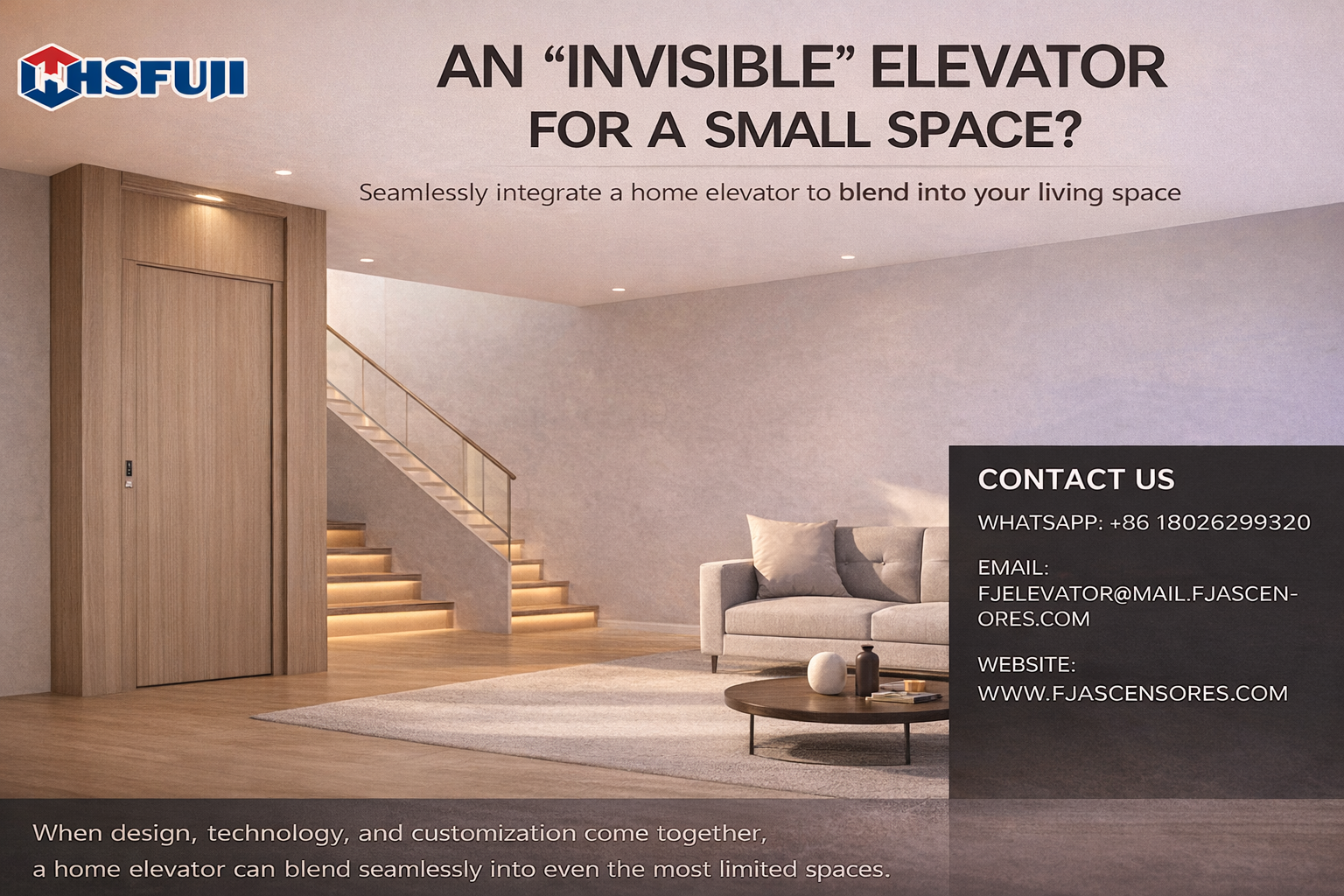
1. The Core of Small-Space Elevator Design: Not “Fitting In,” but “Blending In”
Traditionally, elevators were associated with bulky shafts and a strong sense of mechanical presence. In modern residential design, however, what matters most is spatial continuity and visual harmony.
An elevator can discreetly exist in a limited space through:
Compact Shaft Design
By adopting space-efficient shaft solutions specifically developed for villas and residential buildings, the elevator footprint can be minimized while fully meeting safety standards.
Flexible Placement Options
Instead of occupying the center of the living room, elevators can be installed beside staircases, within wall structures, in corner areas, or even in existing light wells—naturally adapting to the architectural layout.
2. Visual Invisibility: Making the Elevator Part of the Space
A truly “invisible” elevator does not disappear—it simply stops being perceived as a piece of equipment.
Matching Cabin and Landing Door Materials
Elevator doors can be finished with the same materials as surrounding walls, such as wood veneer, stone, or custom panels, allowing them to blend seamlessly into the interior when closed.
Minimalist Lines and Hidden Handles
Clean lines and concealed handles reduce visual interruption, making the elevator feel more like a quiet door than a mechanical system.
Soft, Ambient Lighting Instead of Technical Illumination
Indirect lighting and warm tones help the elevator space feel like a natural extension of the home rather than an industrial installation.
3. When Structure Is “Invisible,” Safety and Performance Must Never Be
Invisible design does not mean compromised standards. On the contrary, small-space elevators demand higher precision, stability, and engineering quality.
Smooth and quiet drive systems suitable for frequent residential use
Multiple safety protection systems to ensure peace of mind for all family members, including children and seniors
Energy-efficient designs that reduce long-term operating costs
A well-designed home elevator works reliably—even when you hardly notice it is there.
4. An Invisible Elevator, a Visible Upgrade in Living Quality
Once fully integrated into the space, the benefits of a home elevator are felt naturally over time:
Effortless movement between floors
A clean, open interior without visual disruption
Enhanced overall property value and long-term living comfort
In high-end residences, an elevator is no longer an “added-on feature,” but an essential part of architectural design.
Limited space does not mean compromising functionality.
A truly mature home elevator solution focuses not only on whether it can be installed, but on how well it fits—structurally, visually, and over the long term.
When design, technology, and customization come together,
an elevator can be quiet,
it can be invisible,
yet its impact on everyday living remains unmistakably real.
 How Do Safety Systems Differ Among Different Types of Home Elevators?