Home
Home HSFUJI
  Jan 08,2026
Freight Elevator Load Selection: What Really Matters
When selecting a freight elevator solution, many customers focus first on one question: “How much load can this elevator carry?”
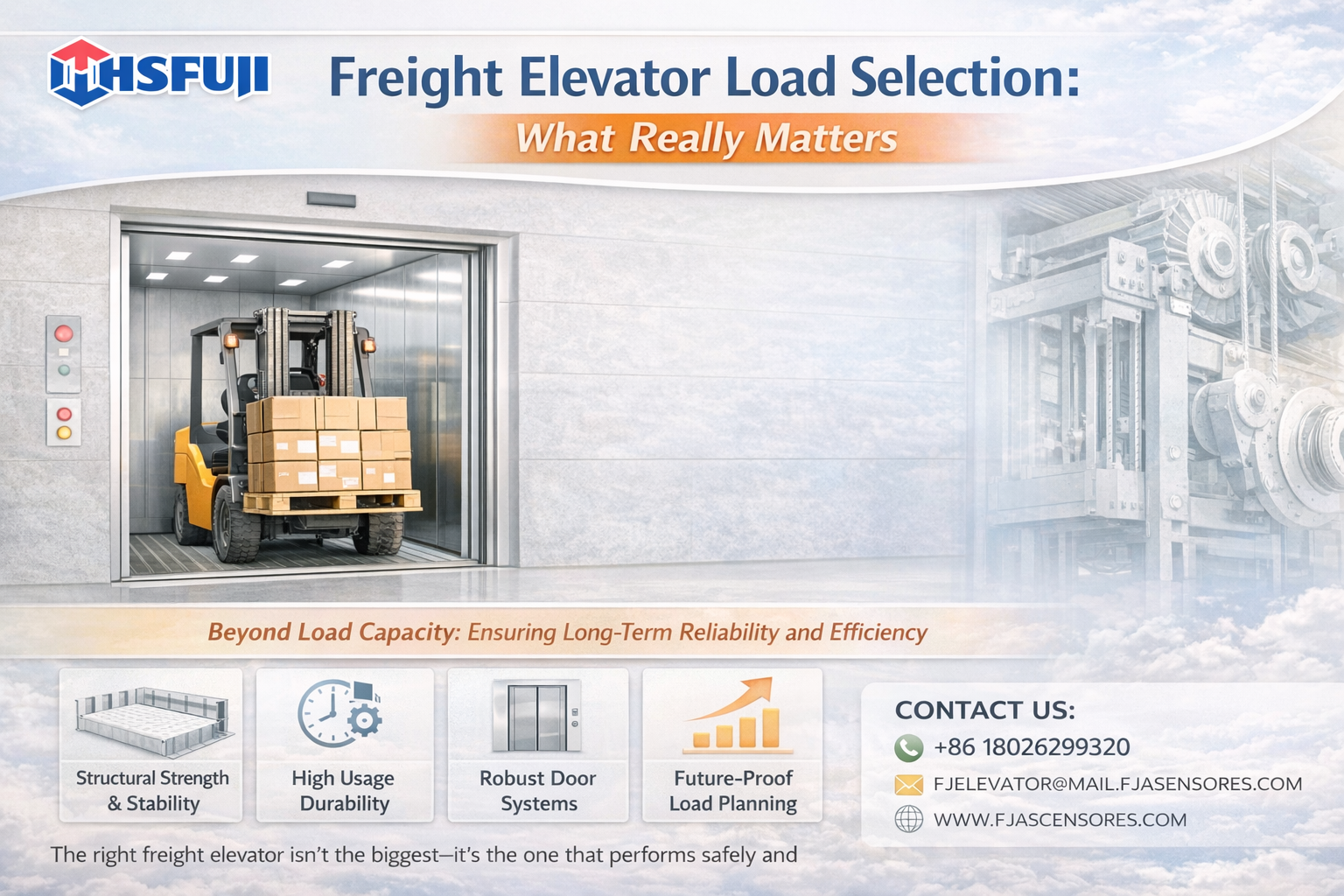
This concern is understandable, but if the decision is based solely on parameter comparison, the selection process can easily drift away from real operational needs. In real-world applications, what determines a freight elevator’s stability and long-term cost is never just a single rated load figure.
A freight elevator that truly fits a project is one that remains reliable over years of operation, not one that simply appears “larger” on paper at the initial stage.
From a technical standpoint, rated load refers to the maximum weight a freight elevator can safely carry under standard conditions. In actual use, however, cargo is rarely uniform in shape, and load distribution is often uneven. Combined with frequent starts and stops, impact loads, and off-center loading, the real stress placed on the system is often much higher than the static weight alone.
For this reason, judging suitability based only on rated load can significantly underestimate long-term operational risks.
Even when two freight elevators share the same rated load, their service life and operational stability can differ greatly. The key factors lie in whether the car structure, frame strength, and guiding system are truly designed to match real working conditions. If structural design is insufficient, prolonged high-load operation will accelerate fatigue and component wear.
In HSFUJI ELEVATOR freight elevator solutions, load capacity is never treated as an isolated parameter—it is designed in parallel with overall structural stability.
Beyond structure, usage frequency is another critical factor in load selection. A freight elevator operating dozens of times per day places very different demands on drive and braking systems than one running continuously at high frequency. Ignoring operating intensity while focusing only on load capacity often leads to premature aging and rising maintenance costs.
A reasonable load configuration must be evaluated together with real operating rhythm and long-term usage cycles.
In practical projects, door systems are often underestimated yet critically important. Frequent forklift access and the handling of large or heavy goods continuously impact door mechanisms and panel strength. If the door system is not properly matched to the load level, it can quickly become the weakest point of the entire elevator system.
A mature freight elevator solution treats the door system as an integral part of the overall load-bearing design.
Looking ahead, logistics demands and production scale often change over time. Reserving an appropriate load margin can support future upgrades and help avoid forced system replacement due to insufficient capacity. However, such margin must be based on sound structural design, not simply inflated specifications.
HSFUJI ELEVATOR consistently emphasizes a balance between forward-looking planning and real operational needs in freight elevator design.
Ultimately, freight elevator load selection is not about finding the “largest possible” solution, but the one that is truly appropriate. A reliable freight elevator should operate stably for many years while keeping maintenance costs predictable. Achieving this requires a comprehensive evaluation of building conditions, usage patterns, and system configuration.
This is the core design philosophy that HSFUJI ELEVATOR upholds across all freight elevator solutions.
The true value of a freight elevator is not measured by how much it can carry in a single trip, but by its ability to complete every operation safely and consistently. When load selection genuinely serves efficiency and long-term use, a freight elevator becomes a dependable foundation for business operations.
 What Is a Freight Elevator?