Home
Home HSFUJI
  Feb 25,2026
Can a Freight Elevator Carry Passengers?
Understanding the Core Difference Between Freight and Passenger Elevators
When selecting an elevator system for commercial or industrial use, many clients raise a common question: can a freight elevator carry passengers? The answer is not simply yes or no, as it depends on how the elevator is designed, certified, and intended to be used. Understanding the functional differences between freight elevators and passenger elevators is essential before making a long-term investment decision.
What Is a Freight Elevator Designed For?
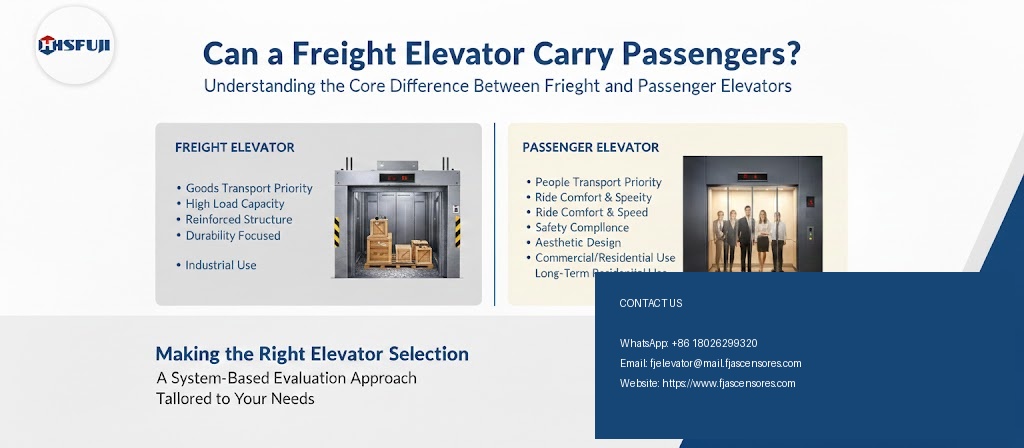
A freight elevator is primarily engineered for transporting goods rather than people. It is commonly installed in warehouses, factories, logistics centers, and commercial storage facilities where durability and load capacity are the main priorities. Compared with passenger elevators, freight models typically feature reinforced cabin structures, higher load ratings, and more impact-resistant door systems, while interior finishes and ride comfort are considered secondary.
Regulatory Considerations and Passenger Safety Compliance
From a regulatory perspective, most standard freight elevators are not designed for regular passenger use unless they are specifically classified and certified as freight-passenger elevators. Safety codes in many regions require passenger elevators to meet additional standards related to leveling accuracy, emergency communication systems, lighting, ventilation, and ride comfort. Using a goods-only elevator for routine passenger transport without proper compliance may create safety risks and legal liabilities.
Technical Differences in Ride Comfort and Operational Design
Although freight elevators are structurally strong and capable of supporting significant weight, they may lack the refinement expected in environments where people travel frequently. For example, stopping precision, vibration control, and cabin finishing are optimized differently in passenger-oriented systems. In certain controlled industrial settings, supervised personnel transport may be permitted, but this does not make a standard freight elevator equivalent to a passenger elevator.
When Is a Freight-Passenger Elevator the Better Choice?
For projects that require both cargo transportation and human access, a freight-passenger elevator is often the more appropriate solution. This type of system is designed to combine high load capacity with full passenger safety compliance, ensuring operational efficiency without compromising safety standards. Selecting the correct configuration from the beginning can prevent costly modifications or regulatory issues later.
A System-Based Evaluation Approach
At HSFUJI ELEVATOR, we approach every project by evaluating actual building structure, usage frequency, and long-term operational needs. Rather than offering a one-size-fits-all solution, our engineering team provides tailored freight and passenger elevator systems designed to meet both safety regulations and performance expectations. This system-based evaluation ensures that each installation delivers reliable performance throughout its service life.
Making the Right Elevator Selection
In conclusion, while certain freight elevators may technically carry personnel under specific conditions, they are not automatically suitable for regular passenger use. The decision must be based on certification, safety compliance, and intended application. Choosing the right elevator system from the outset is essential for ensuring both safety and long-term operational stability.
For more information about freight elevator systems and customized lifting solutions, please visit: https://www.fjascensores.com
 The Most Suitable Home Elevator Systems for Villas